

There are no items in your cart


Mid Calf vs Knee High Boots
Quick Summary
Choosing between mid calf vs knee high boots comes down to four answers. A knee high shaft finishes one to two finger widths below the bend of your knee, and a mid-calf stops below the widest part of the calf. The calf opening has to close over the widest part of your leg with room for tights. A 1.5 inch to 2 inch block heel is the all-day range. Leather holds a tall shaft upright, suede drapes. Antelope handcrafts knee high and mid-calf boots from $139 to $249, with free shipping in the US on orders over $80.

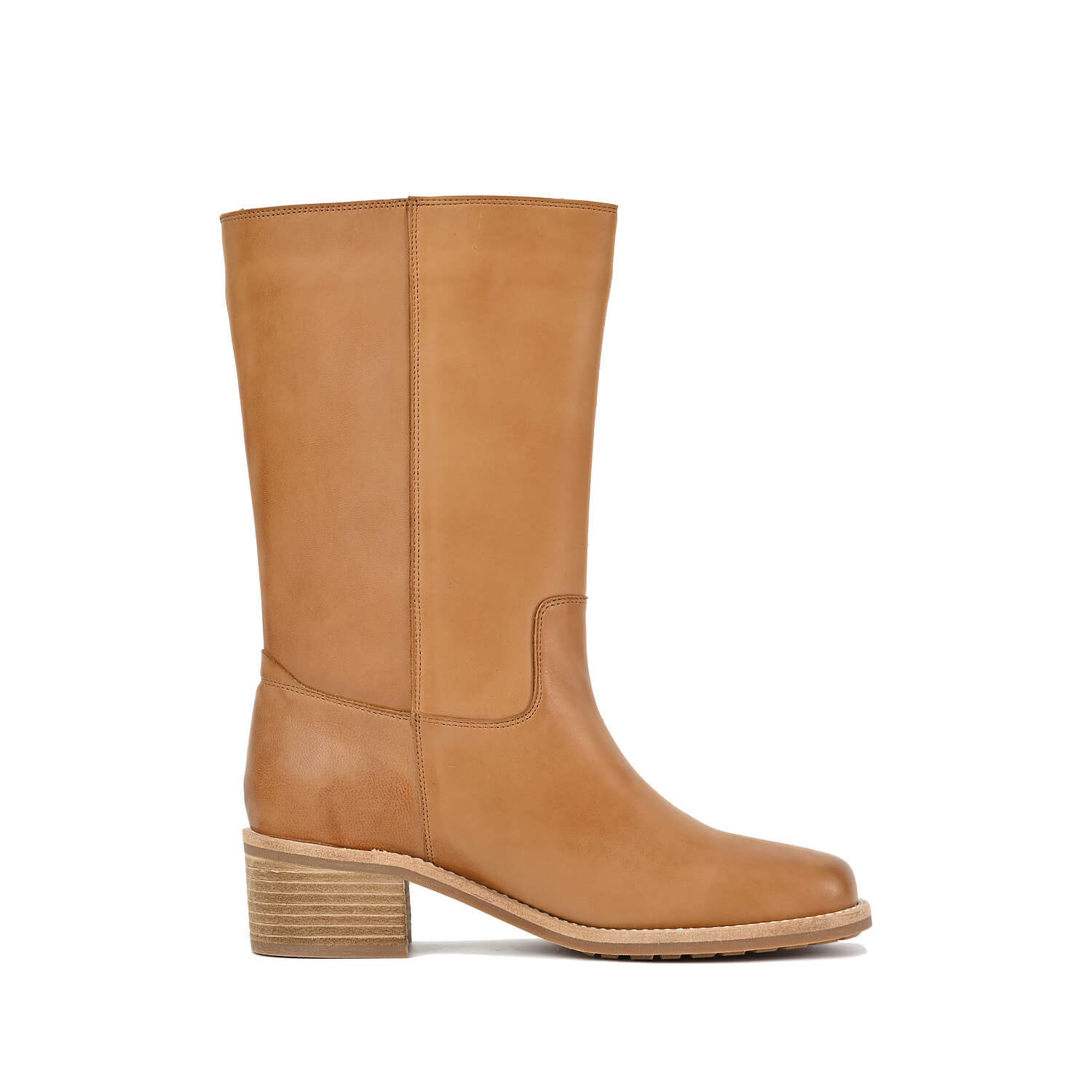
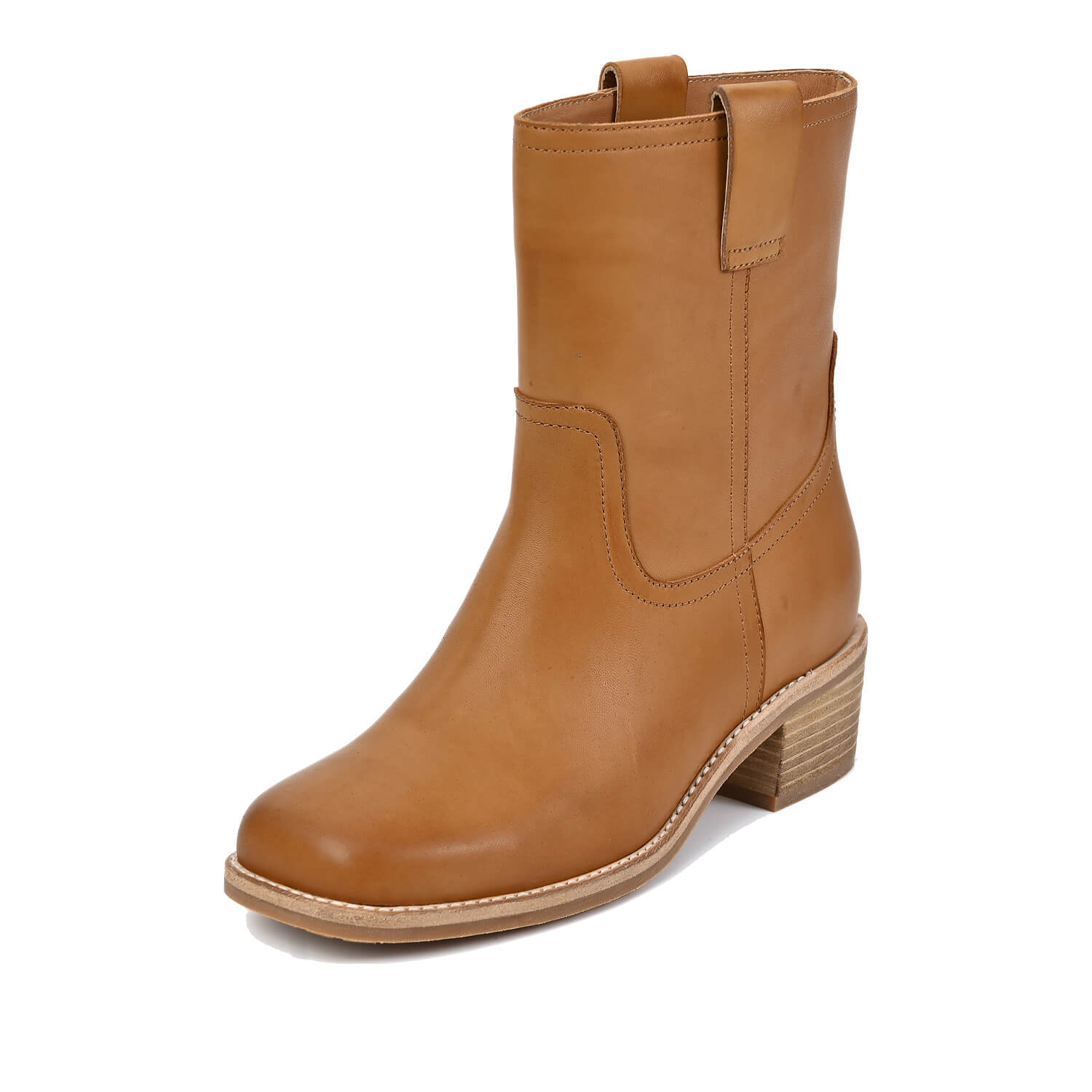
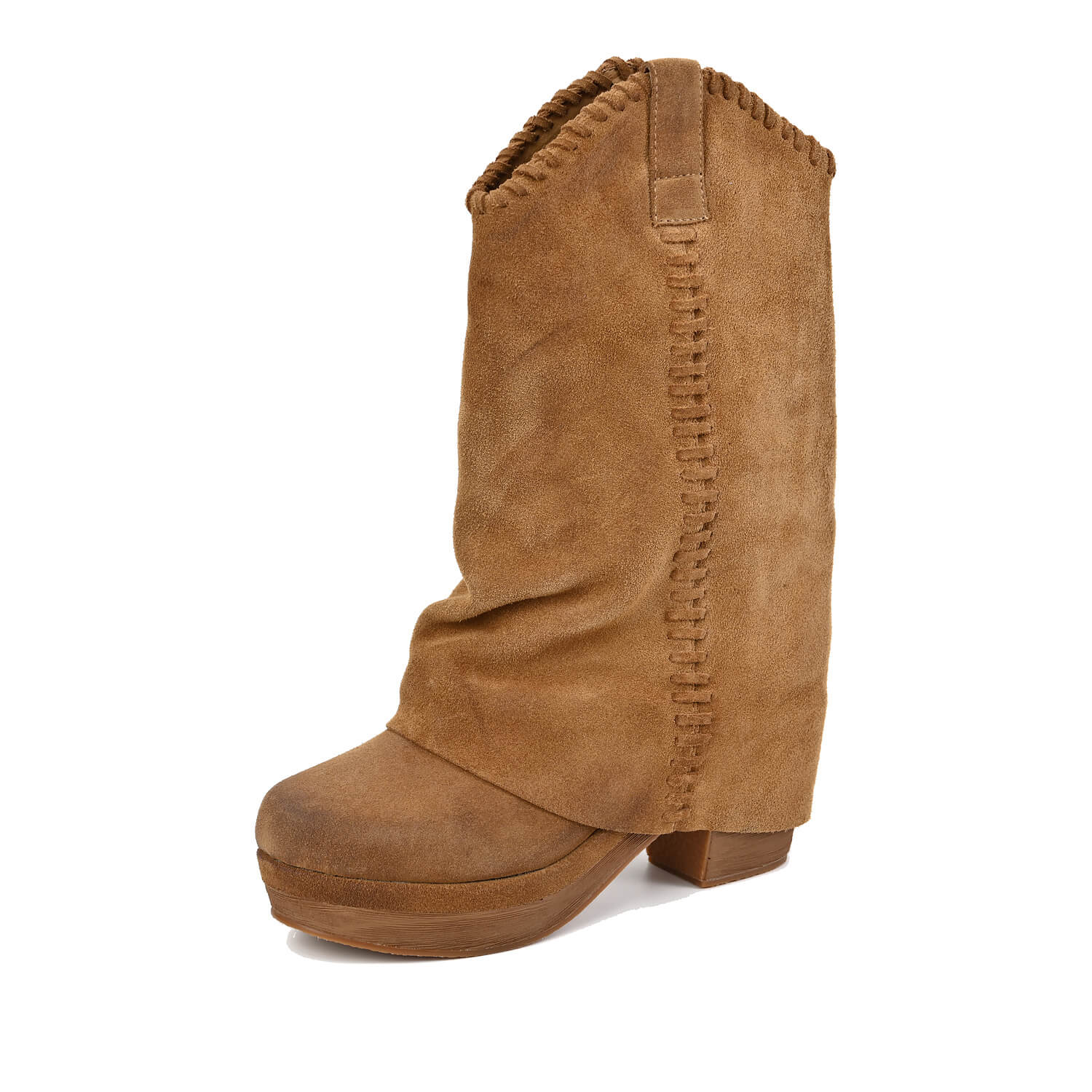
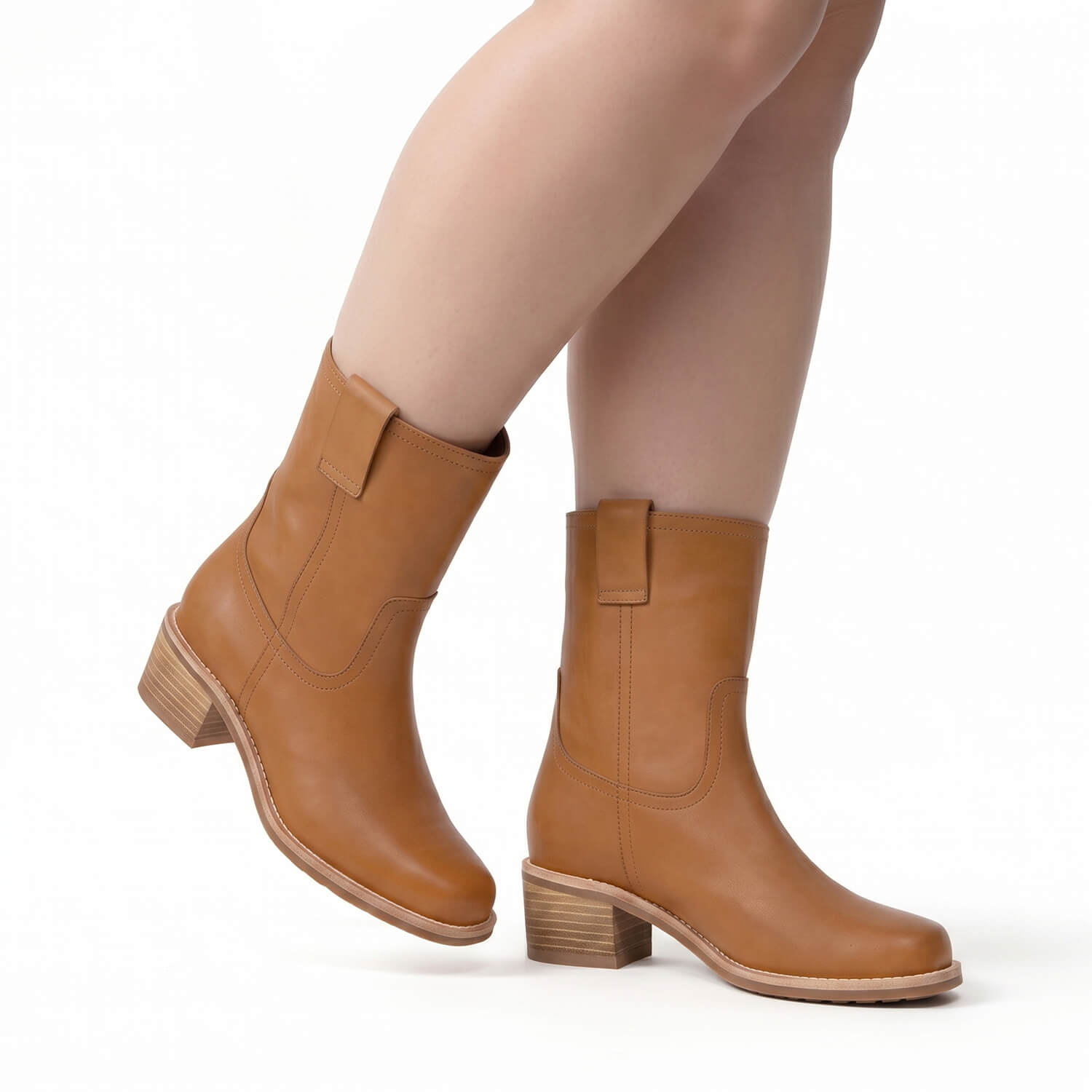
Left, the M59 Celeste finishes at mid-calf. Right, the O46 Tessa rises toward the knee.
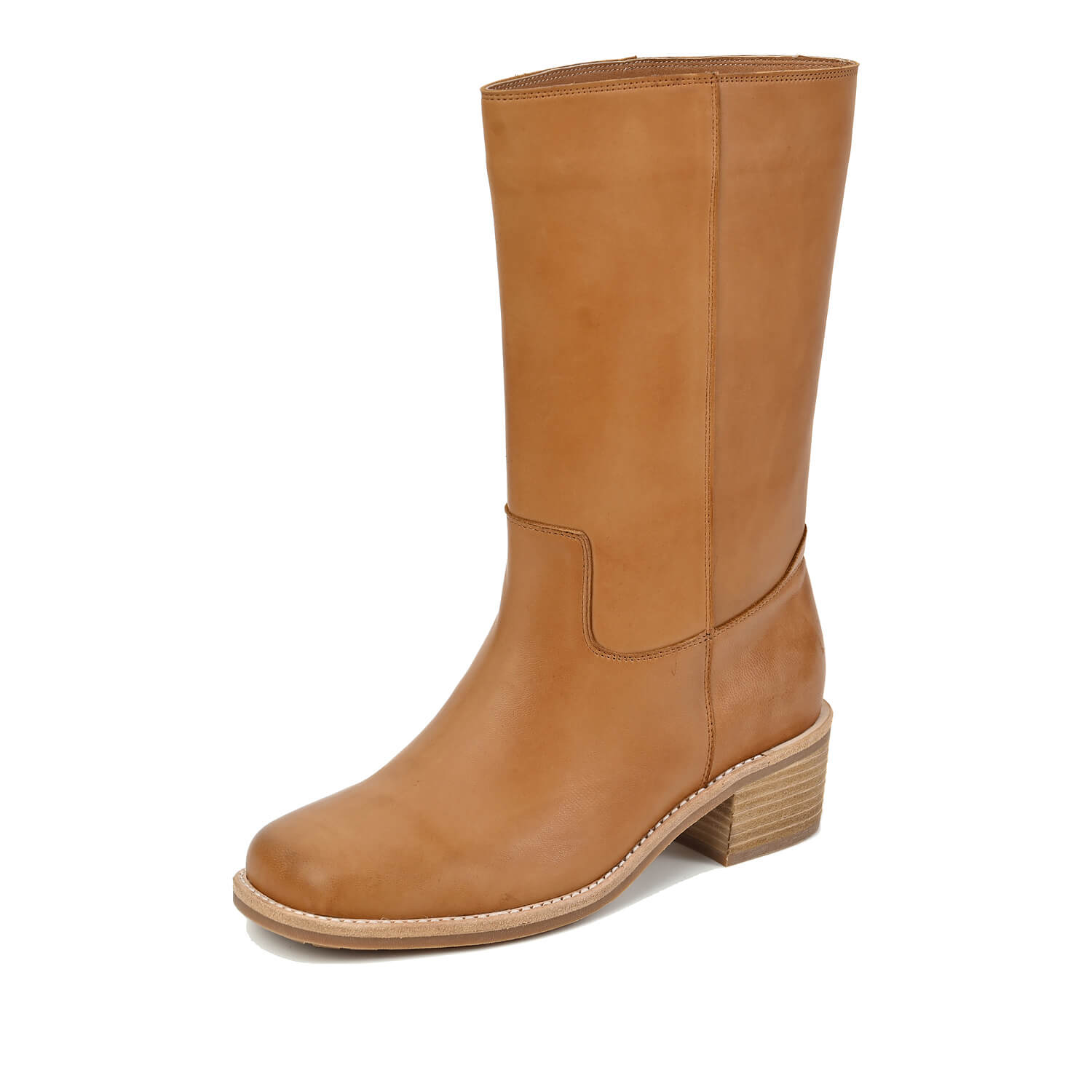
Editor's Pick
★★★★★
Mid-Calf Leather Shaft, 1.5 Inch Stacked Heel
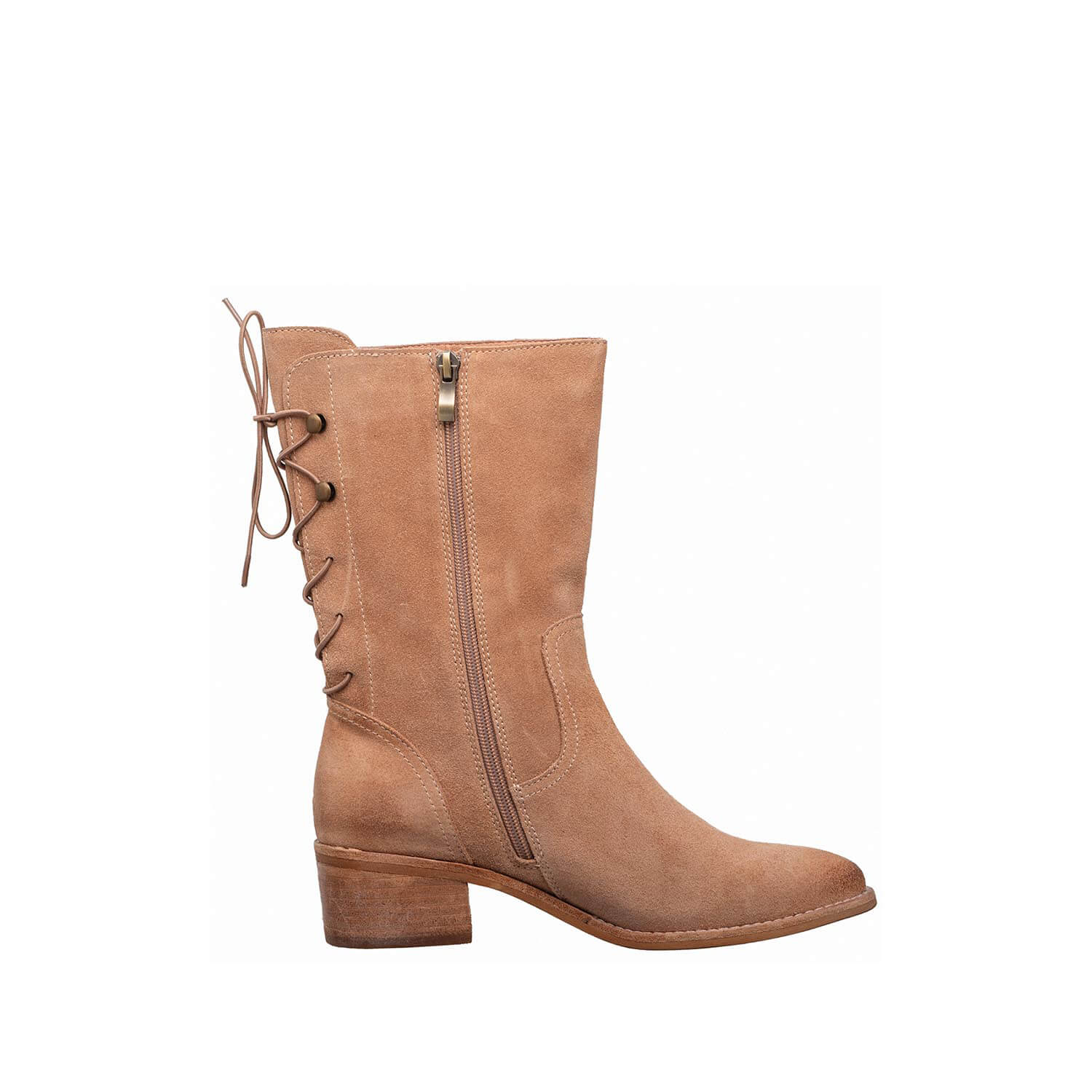
The clean leather mid-calf. Hand-brushed oiled leather in Taupe rises well above the ankle and finishes at mid-calf, and the shaft is cut to stand rather than collapse into folds. A stacked 1.5 inch block heel and a cushioned interior make it a boot you can wear through a full day, and each pair is handcrafted in small batches.
$249
Shop M59 Celeste
The Seven Pairs in This Guide
In This Guide
- 01Mid Calf vs Knee High Boots, What Each Height Means
- 02Where the Shaft Should End on Your Leg
- 03Measure Your Calf Before You Buy
- 04Heel Height You Can Wear All Day
- 05Closure, Pull-On, Zip, Lace-Back or Fold-Over
- 06Leather or Suede, and How to Care for Each
- 07Colour, and the Shades That Work Hardest
- 08How to Wear Knee High Boots
- 09Mid Calf vs Knee High Boots, How to Decide
- 10Seven Boots, From Knee High to Mid-Calf
- 11Frequently Asked Questions
Mid calf vs knee high boots is the choice most women weigh once the weather turns, and it decides whether a new pair gets worn or goes back. The reason is rarely the colour or the leather. It is fit. The top of the shaft hits the back of the knee every time you sit, the zip stops short of closing over the calf, or the heel that looked elegant in the photograph is too steep for an afternoon of walking. Every one of those problems can be seen coming before you order.
The Short Answer
Settle mid calf vs knee high boots in this order. Shaft height first, a knee high should sit one to two finger widths below the bend of your knee and a mid-calf below the widest part of your calf. Calf fit second, measure the widest point and choose an adjustable shaft if you fall between sizes. Heel third, 1.5 to 2 inches on a block is the all-day range. Material and colour last.
That order follows what you can and cannot change after the boots arrive. A shaft that is too tall cannot be shortened. A calf opening that is too narrow will not open up much. A steep heel can be lived with for an evening, and colour is a genuine preference. Work down the list in that sequence and you will not end up with a beautiful pair that stays in the closet.
This guide is written from the workshop side. Antelope handcrafts its tall leather boots in small batches, and the leather on the styles below is hand-brushed or hand-finished before the boot is assembled. Every height named here is read from how the boot sits on the leg in our own photographs, and every heel and closure from the boots themselves.
Mid Calf vs Knee High Boots, What Each Height Means
A knee high boot is a boot whose shaft rises to the knee or slightly below it, covering the whole calf and finishing under the knee joint rather than on it.
The shape comes from the saddle. The classic riding boot was cut high enough up the leg to stop the saddle leathers from pinching the rider, and most fashion knee high boots have kept that proportion while losing the stiffness. The reference entry on the knee-high boot notes that they are usually closer around the ankle and lower shaft than at the top, which is exactly why fit at the calf matters so much.
In practice, three shaft lengths are sold under overlapping names, and it helps to separate them.
True knee high. The shaft finishes one to two finger widths below the bend at the back of the knee. It covers the whole calf and reads as a single long line from toe to knee.
Tall. A broader word for any shaft that clears the widest part of the calf. Many boots sold as tall finish a few inches lower than a true knee high, which is not a flaw, simply a different proportion. Most of the boots in our own collection that carry the word tall finish lower still, at mid-calf.
Mid-calf. The shaft stops below the widest part of the calf. It is easier to fit, easier to wear with a longer skirt, and the natural alternative when a knee high will not close over your leg.
Here is mid calf vs knee high boots side by side, before the detail that follows.
| Knee high | Mid-calf | |
|---|---|---|
| Boot shaft height | One to two finger widths below the bend of the knee | Below the widest part of the calf |
| Calf fit | The shaft has to close over the whole calf | Easier, the shaft stops at or below the widest point |
| Wears best with | Skirts and dresses, the longest line from toe to knee | Jeans and trousers, over or under, and longer skirts |
| On and off | Slower, the full shaft has to pass the calf | Quicker, a better fit for a pair worn every day |
| In this guide | O46 Tessa | M59 Celeste, M61 Celeste, M64 Colbie, O41 Trinity |
Which of these a boot turns out to be depends on your leg as much as on the boot, and that is the subject of the next section.

Where the Shaft Should End on Your Leg
Boot shaft height is what decides whether a pair reads as knee high or mid-calf on you. The top of a knee high boot should sit one to two finger widths below the crease at the back of your knee. Any higher and the leather presses into the joint every time you sit, climb a step or bend to pick something up. Any lower and the boot starts to read as a mid-calf, which is fine if that is what you want and disappointing if you ordered a knee high.
There is a quick way to check this before you buy. Standing barefoot, measure from the floor to the crease behind your knee. Take away the heel height of the boot you are considering, then take away about an inch for clearance. The number left is the tallest shaft that will sit comfortably on your leg, measured the way boot shaft height is usually measured, from the arch of the boot to the top of the shaft.
Knee high boots for women are cut to an average leg, so petite and tall legs are where this matters most. On a shorter leg, a standard knee high shaft can reach the knee itself, and a boot sold as mid-calf may land exactly where a knee high would on a taller woman. On a longer leg the reverse happens, and a boot sold as knee high can finish mid-shin. Neither is wrong. It simply means the product name is a starting point and your own measurement is the answer.
Remember, too, that leather settles. A tall leather shaft relaxes a little at the ankle over the first weeks of wear, and the top drops slightly as it does. A shaft that sits just a touch high on the first day will usually find its place, while one that already sits low will only sit lower.
Boot Finder Quiz
Your Boot Height
Question 1 of 3
How much heel can you wear all day?
Whichever pair the quiz suggests, study the shaft first. The short clip below shows the O41 Trinity on the leg, so you can see where a mid-calf shaft finishes and how the lace-back sits around the calf.
Blush Suede Lace-Back Mid-Calf Boots #Shorts
The O41 Trinity in Blush suede, filmed on the leg. Watch where the shaft finishes below the calf, the lace-back that sets the fit, and the side zipper that gets you in.
- Hand-finished Blush suede upper
- Adjustable lace-back shaft
- Side zipper for getting in
- Padded, insulated lining
- Block heel
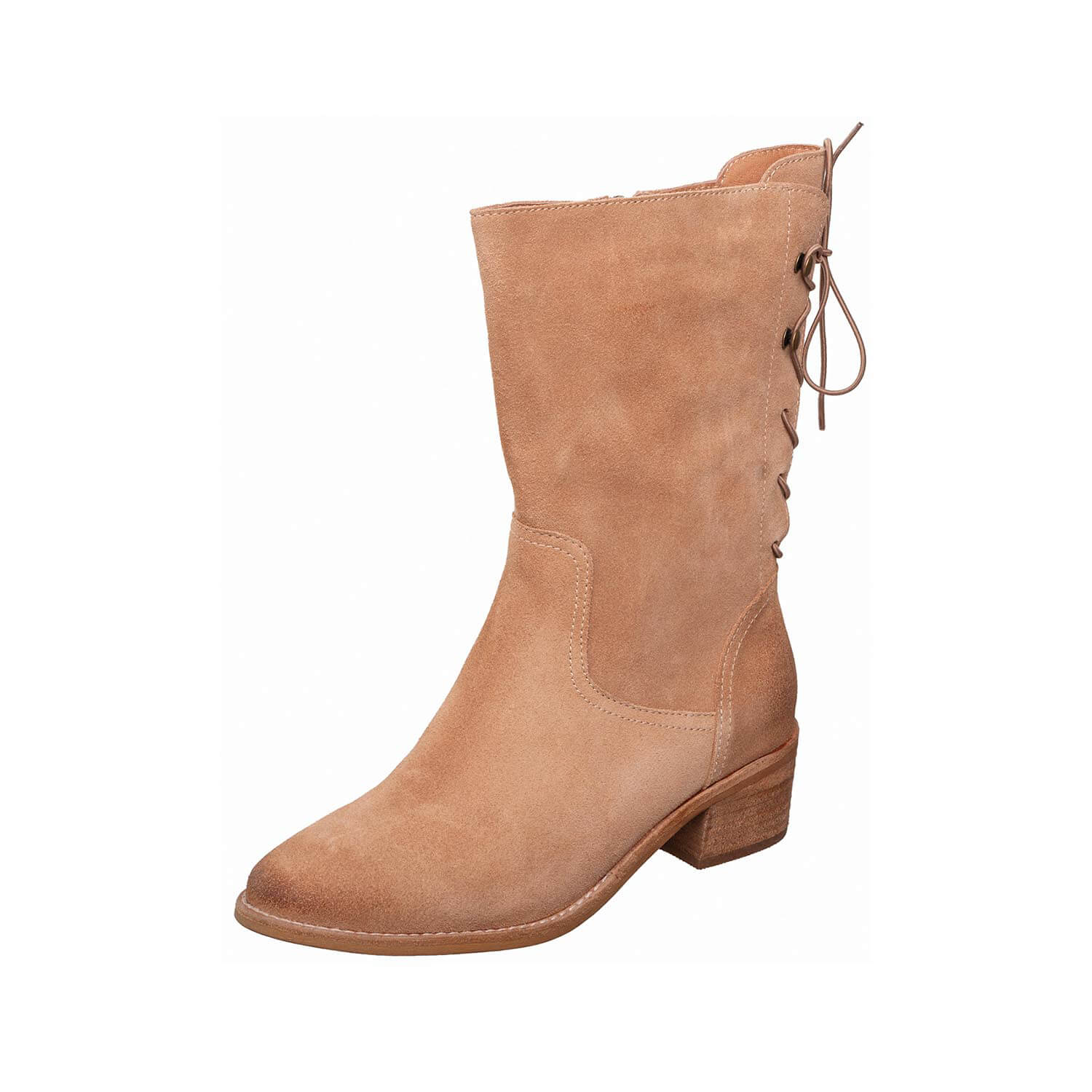
The lace-back is the detail to watch in that clip. It lets the shaft close around your own calf rather than an average one, which is why the O41 is the pair in this guide for calves that are hard to fit.
Measure Your Calf Before You Buy
Calf fit is the part of a knee high that is hardest to judge from a photograph. A shaft that looks generous in a photograph can still stop short of closing over the widest part of the leg, and a zip strained over a tight calf is uncomfortable within the hour. Measure it properly once and you will not need to guess again.
- Wrap a soft tape measure around the fullest part of your calf, usually a few inches below the back of the knee.
- Many fitters measure seated with the foot flat, because the calf spreads slightly when you sit, and that is the position a boot has to accommodate on a long drive or a long dinner.
- Wear the tights, leggings or jeans you plan to wear with the boots. Denim tucked into a shaft adds noticeably to the measurement.
- Compare the number with the shaft circumference if the product page lists one, and leave a little room so the leather does not grip.
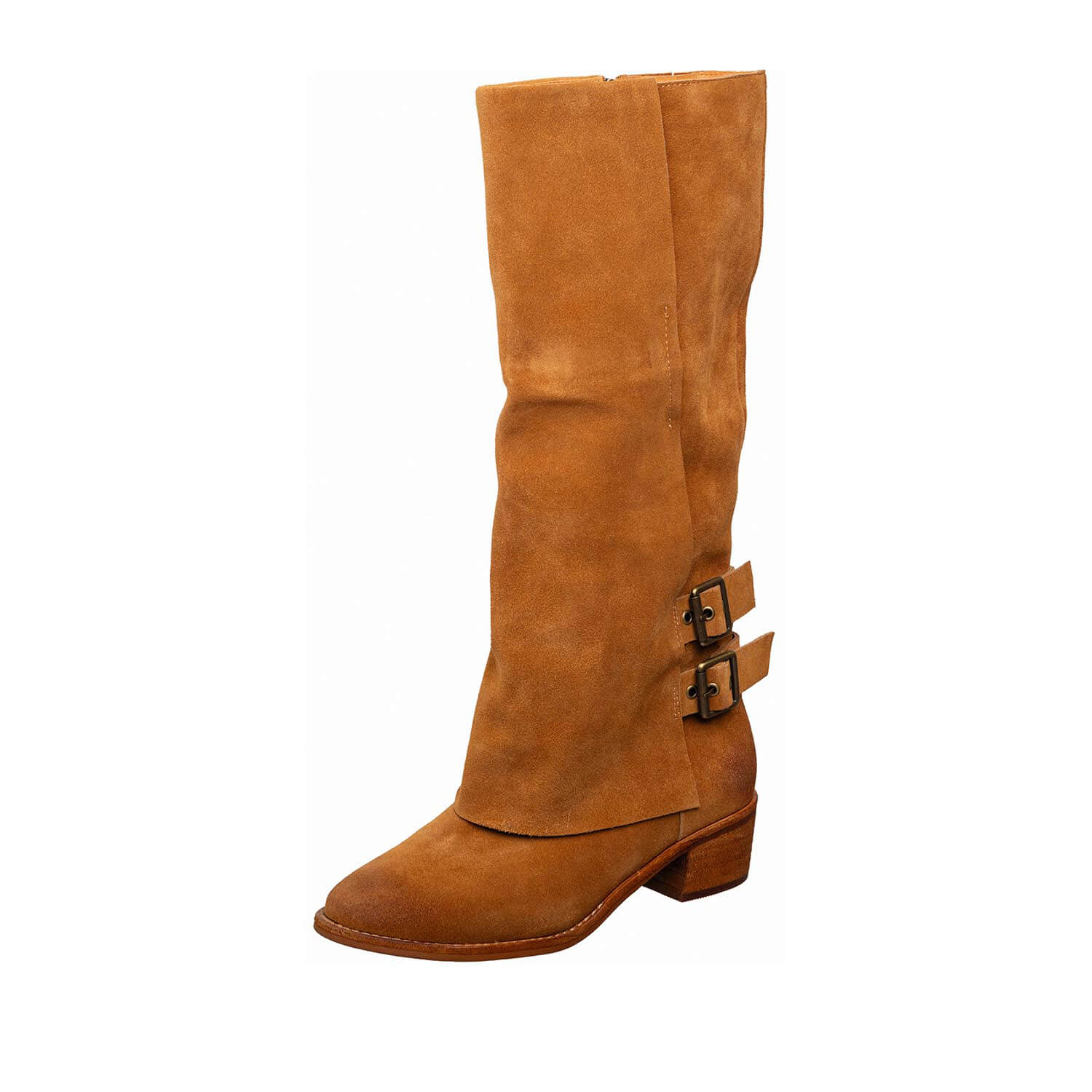
If a boot does not list its circumference, or you sit between sizes, the answer is to choose a shaft that adjusts rather than one that has to match exactly. There are two such shapes in this guide. The O41 Trinity has a lace-back that lets you open or close the shaft around your calf, and the R39 Talia has a fold-over suede shaft that drapes around the leg instead of holding a structured line. Either will forgive a measurement that a fixed tall shaft would not.
Wide calf knee high boots are cut with a larger circumference along the whole shaft. If your measurement is well above average and a boot does not state its circumference, an adjustable lace-back or a mid-calf height is the safer order than a fixed tall shaft.

Heel Height You Can Wear All Day
Heel height is the second thing that decides how many hours a knee high or mid-calf boot is genuinely wearable. A long shaft already makes a strong statement, and it pairs best with a heel you can walk in rather than a heel you have to plan around.
Every inch of heel moves more of your weight forward onto the ball of the foot. At 1.5 inches the shift is small, and a stacked block heel at that height walks almost like a flat. At 2 inches you gain visible lift and still get through a full day. At 3 inches the boot becomes an evening piece, unless a platform sole is doing some of the work.
The width of the heel matters as much as its height. A block or stacked heel puts a broad base on the ground, so your ankle does less correcting with each step, which is why every boot in this guide uses one rather than a slim heel.
The heel ladder, in stock now
| Boot | Shaft | Heel | Best for | Price |
|---|---|---|---|---|
| M59 Celeste | Mid-calf | 1.5 inch stacked block | Full days, a clean leather line | $249 |
| M61 Celeste | Mid-calf | 1.5 inch stacked block | Full days, with a braided detail | $249 |
| M64 Colbie | Mid-calf | 1.5 inch stacked block | Everyday wear, pull-on ease | $239 |
| M75 Nyssa | Short, above the ankle | 2 inch block | Work days that end out | $139 |
| R39 Talia | Fold-over, worn up or down | 3 inch on a platform | Height with a gentler pitch | $239 |
If you are unsure, 1.5 inches is the answer for a tall boot. It is enough lift to keep the long line elegant and low enough that a full day on your feet does not become an endurance test, which is why the M59, M61 and M64 all sit at that height. The O41 Trinity also stands on a block heel, and it is the pair covered under calf fit above.
A platform is the exception to the ladder. The R39 Talia fold-over boot pairs a platform sole with a stacked block heel for a 3 inch heel height, and because the front of the foot is lifted too, the angle your foot actually sits at is gentler than the number suggests.

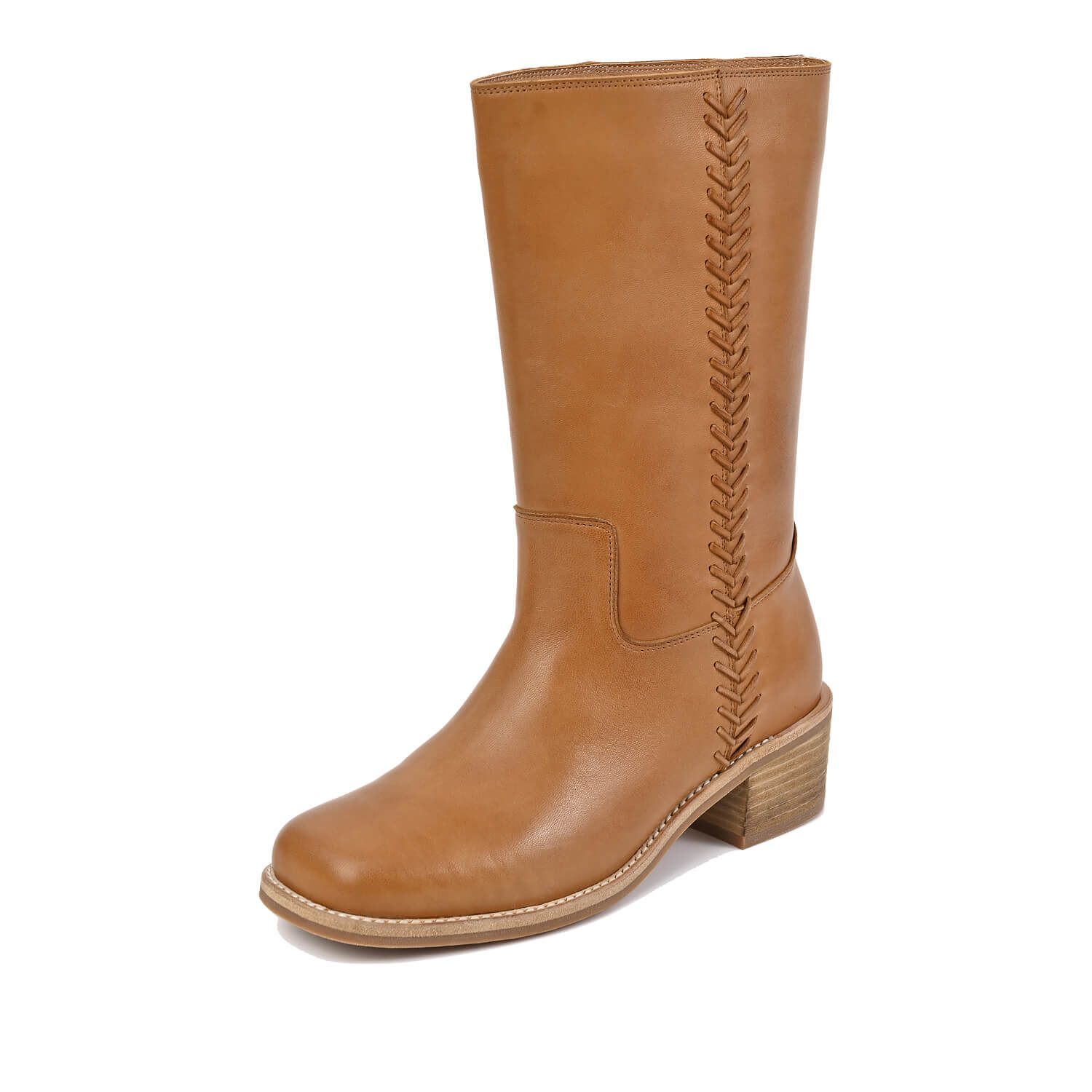
Featured Style
★★★★★
Mid-Calf Leather Boot, Braided Seam, 1.5 Inch Heel
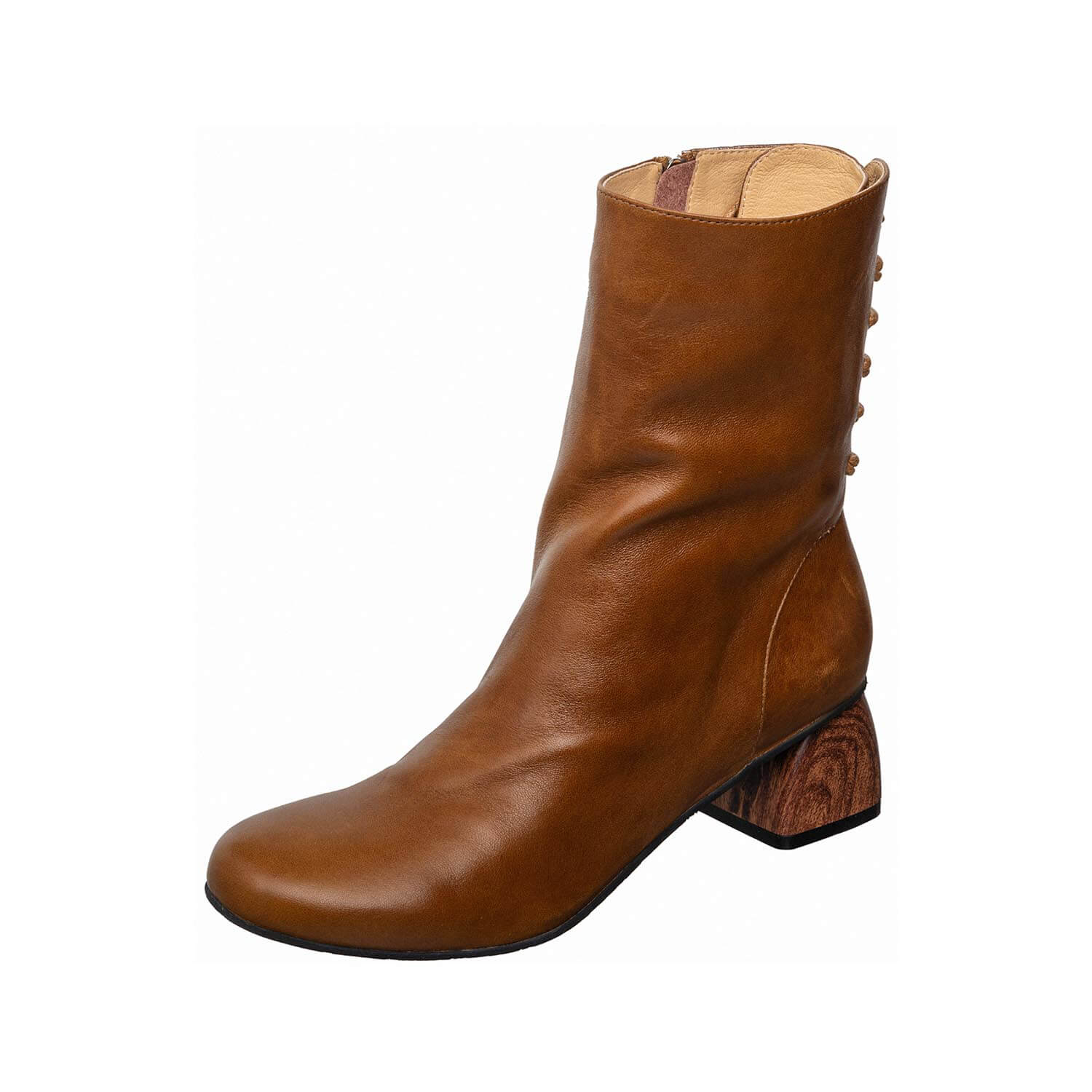
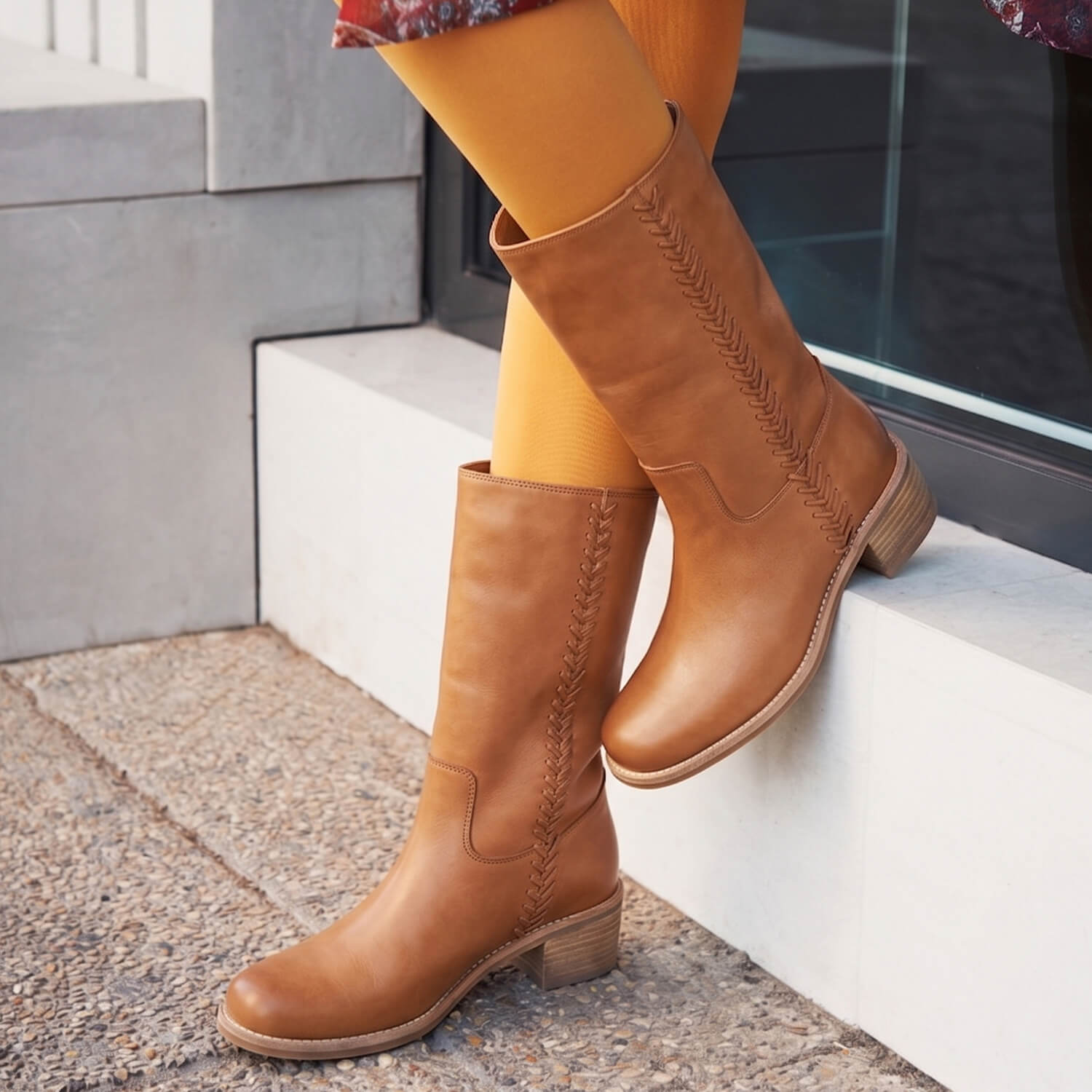
The same hand-finished Taupe leather and 1.5 inch stacked block heel as the M59, with one difference you notice from across a room. A leather braid is worked by hand into the seam that runs the length of the shaft, and the line of the boot is slightly more sculptural. A plush cushioned footbed keeps it wearable through a full day.
$249
Shop M61 Celeste
Know your height and heel already?
The knee high and mid-calf range is in stock now, with free shipping in the United States on orders over $80.
Closure, Pull-On, Zip, Lace-Back or Fold-Over
Closure decides how easily a tall boot goes on, how it holds the calf, and whether it works with a fuller instep. With a shaft this long, it is worth settling before you order, because each closure solves a different problem.
Pull-on
A pull-on boot has no hardware on the shaft at all, so the leather runs unbroken from the ankle to the top. Pull tabs make it quick to get in, and the clean shaft is the most elegant look under a skirt. The trade-off is that the opening is fixed, so your calf measurement has to fit. The M64 Colbie pull-on boot is cut this way, with tabs to pull it straight on.
Side zip
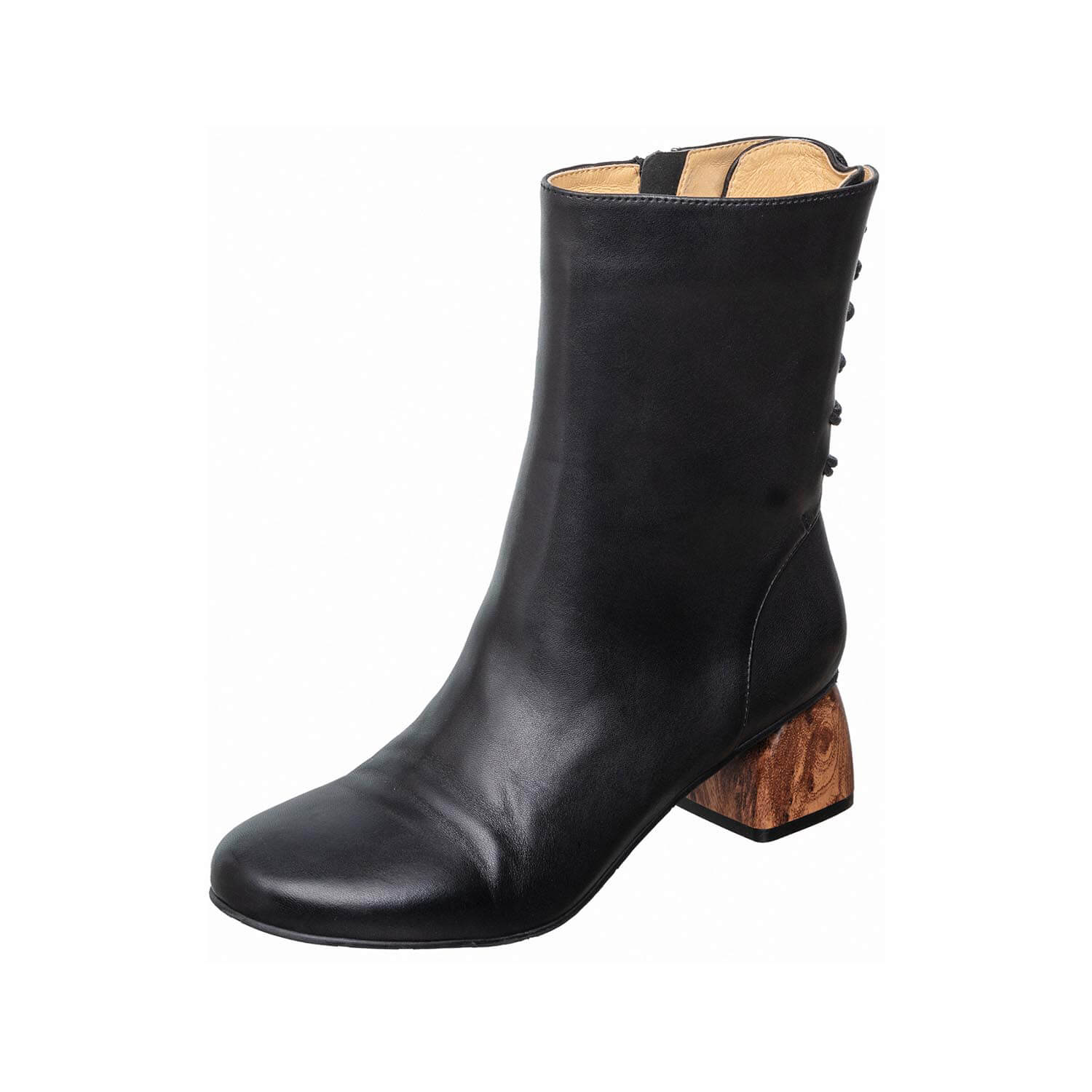
A side zip is the most familiar closure on tall boots. It opens the shaft fully so you can step in, and it lets you see exactly how the boot closes over your calf before you commit to wearing it out. The M75 Nyssa side-zip boot uses one along a soft nappa leather shaft, and so does the O41 Trinity.
Lace-back
The most forgiving closure for calf fit. Laces running up the back of the shaft let you set the width yourself, a little looser over jeans and a little closer over tights. The O41 Trinity pairs a lace-back with its side zip, so you get in easily and then adjust the fit to your own leg.
Fold-over
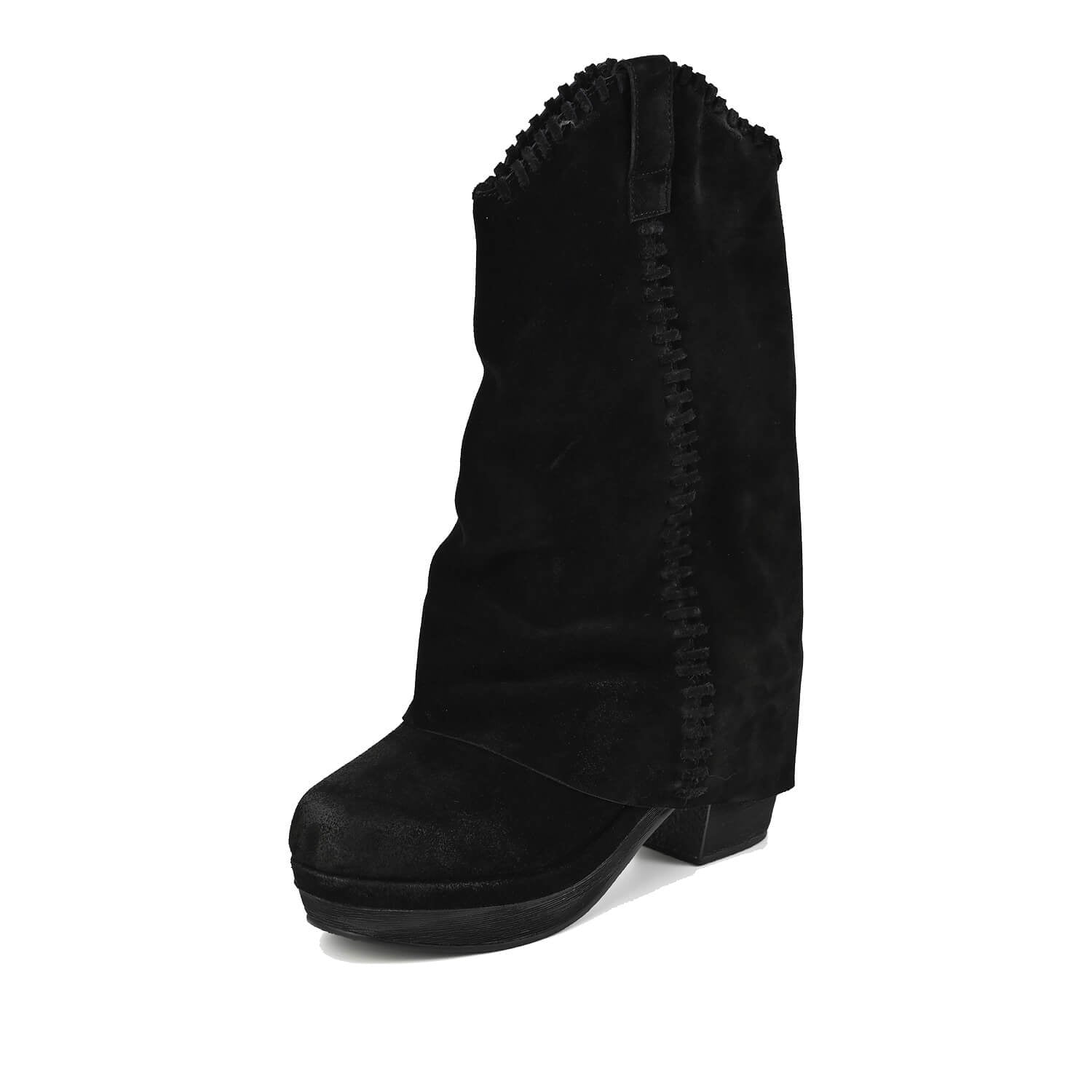
A fold-over shaft is two heights in one boot. Worn up, the R39 Talia gives more coverage on the leg. Turned down, it becomes a slouchier, shorter boot with the suede cuff on show. The shaft drapes rather than holding a structured line, which suits a wider range of calves than a fixed tall shaft. Our guide to fold over boots covers more ways to wear the shape.

Hand-brushed Camel leather at mid-calf height, pulled straight on by its tabs, with a contoured cushioned insole that supports the arch.
$239

Soft nappa leather at mid-calf, a side zipper and a 2 inch block heel over a cushioned insole with arch support. In Black and Whiskey.
$139
Blush suede at mid-calf with an adjustable lace-back and a side zipper, over a padded, insulated lining and a block heel.
$139
Leather or Suede, and How to Care for Each
Leather and suede behave very differently in a tall boot, and the difference shows most in the shaft.
Smooth leather has the structure to stand on its own. A tall leather shaft like the one on the M59 Celeste is cut to hold its line rather than collapse into folds, which is what gives leather knee high boots their long, clean silhouette. Leather is also the easier material to live with day to day. Care is simple. Wipe the boots with a soft dry cloth after wear, and condition the leather a few times a season so it stays supple.
Suede is softer and drapes. That makes it the natural material for fold-over and slouched shapes, where movement is the whole point, and it feels soft against the leg from the first wear. In exchange it is porous. Treat a suede boot with protector spray before its first outing, lift dust with a suede brush, and never dry it next to direct heat. Our guide on how to care for suede takes you through the rest step by step, and the same care applies to our suede ankle boots.
If you want a single pair to wear from the first cold morning to the end of the season, leather knee high boots are the safer choice. Choose suede when you want softness and a relaxed line, and keep a leather pair for wet days.

Colour, and the Shades That Work Hardest
Black is the reflex choice for knee high boots, and it works, but on a boot that covers most of the lower leg it is also the heaviest colour you can pick. A mid-tone brown or taupe carries more of a wardrobe.
Taupe bridges grey, navy, cream and camel without looking planned, and it softens the long line of a tall shaft rather than cutting across it. Both Celeste styles are made in it. If you are looking for brown knee high boots, taupe, camel and whiskey are the three browns worth comparing. Camel and whiskey are the warmer two, with a lot of life against denim, olive and rust, and the M64 Colbie and M75 Nyssa cover them. Blush, on the O41 Trinity, is the quiet surprise, lovely with grey, cream and soft knits. Black is there when you need it, in the M75 Nyssa and the R39 Talia. Brown knee high boots in a mid-tone also hide the light dust and scuffs that show quickly on black.
How to Wear Knee High Boots
Knowing how to wear knee high boots comes down to proportion, and once the proportions are right they are one of the easiest shapes to style. Four outfits cover most of the season.
With a midi skirt or dress
The classic pairing. Let the hem fall just over the top of the boot, or leave a small gap of tights or leg between them, and avoid a hem that ends exactly where the shaft does. Brown knee high boots in taupe or camel with a knit midi are the easiest outfit of the season.
Over slim jeans or leggings
Tuck slim jeans or leggings inside the shaft for a clean, long line. This is where calf fit matters most, because denim adds bulk, so measure with the jeans on. A pull-on shaft like the M64 Colbie or a side zip like the M75 Nyssa both work here.
With a longer coat
A coat that finishes around the top of the boot creates one uninterrupted line from shoulder to toe, which lengthens the leg more than any heel. Keep the boot and the coat in related tones for the strongest effect.
With tights and a shorter skirt
Opaque tights in a colour that picks up the boot, or contrasts with it on purpose, turn the boot into the centrepiece of the outfit, whether it stops at the knee or at mid-calf. In our own photographs the M61 Celeste, a mid-calf style, is shown with mustard tights, and the braided seam stands out best against a solid colour like that.
Found the outfit, now the boot?
A knee high in suede, fold-over suede and mid-calf leather, handcrafted and in stock from $139.
Mid Calf vs Knee High Boots, How to Decide
If you are torn between mid calf vs knee high boots, the question is less about fashion than about your leg and your days.
Choose a knee high if you want the longest possible line, you wear skirts and dresses more than trousers, and a fixed shaft closes comfortably over your calf. Choose a mid-calf if your calf is at the upper end, you are petite and standard knee highs reach your knee, you drive a lot, or you want a boot that works over and under trousers equally well. Mid-calf boots are also quicker to get on and off, which matters on a pair you wear every day.
Many women end up owning one of each. A knee high for skirts and a mid-calf for jeans covers almost every outfit. Our guide to comfortable mid calf boots goes deeper on the shorter shaft, and our look at women's tall boots covers more of the taller shapes.
5 to 10
US sizes in stock
$139
Where these boots start
$80
Free US shipping above
Seven Boots, From Knee High to Mid-Calf
These seven cover every answer above. One reaches the knee, four rise to mid-calf for easier fit and everyday wear, one folds between heights, and one keeps a shorter shaft above the ankle. Between them there is a pair for every combination of shaft, heel and closure.
O46 Tessa, the knee high
The one boot in this edit that reaches the knee. Brushed suede with a subtle wax finish rises to just below the knee, two buckles sit on the shaft, and a full side zipper makes it easy to get on. A cushioned insole and a low, stable heel keep it wearable through the day. In Cognac at $179.

M59 Celeste, the clean leather mid-calf
The pair for a long, plain leather line without the fit demands of a knee high. Hand-brushed oiled leather in Taupe rises well above the ankle and finishes at mid-calf, and the shaft is cut to hold its shape rather than collapse into folds, so it stays elegant from the first hour to the last. The heel is a stacked 1.5 inch block, the interior is cushioned, and each pair is handcrafted in small batches. Care is a soft dry cloth after wear and a leather conditioner a few times a season. In US sizes 5 to 10 at $249.
M61 Celeste, the mid-calf with a detail
Choose this one over the M59 if you want the boot to be noticed. The hand-finished Taupe leather rises to mid-calf on the same 1.5 inch stacked block heel, and a leather braid worked by hand runs into the seam along the full length of the shaft. The line is slightly more sculptural, and a plush cushioned footbed sits inside. In US sizes 5 to 10 at $249.
M64 Colbie, the pull-on mid-calf
The easiest boot of the seven to live with. Hand-brushed leather in Camel rises to mid-calf, and the boot pulls straight on by its tabs with no hardware on the shaft, so the leather line stays clean. A contoured cushioned insole supports the arch, and the stacked block heel is 1.5 inches. In US sizes 5 to 10 at $239.
R39 Talia, the fold-over
Two boots in one. The suede shaft is worn up for more coverage or folded down for a slouchier look, and the seam is whipstitched by hand. A platform sole sits under a stacked block heel for a 3 inch heel height, with a padded insole inside. In Taupe and Black, US sizes 5 to 10, at $239. Treat it with protector spray before the first wear, brush it every few wears, and keep it away from direct heat.
M75 Nyssa, the value pick
Soft nappa leather on a short shaft that finishes above the ankle, a 2 inch block heel and a side zipper that makes it quick to get on. A cushioned insole with arch support keeps it comfortable through a working day. In Black and Whiskey, in US sizes 5 to 8, at $139, down from $239.
O41 Trinity, the adjustable calf
The pair for anyone whose calves are hard to fit. Blush suede rises to mid-calf, and a lace-back lets you set the shaft around your own leg, while a side zipper does the work of getting in. A padded, insulated lining and a block heel finish it. In US sizes 5 to 10 at $139, down from $239.

Frequently Asked Questions
What is the difference between mid calf and knee high boots?
Where the shaft ends. A knee high finishes one to two finger widths below the bend of the knee and covers the whole calf. A mid-calf stops below the widest part of the calf, which makes it easier to fit over a fuller calf, quicker to get on and easier to wear with trousers. A knee high gives the longer line and more coverage in cold weather.
How high should knee high boots come up on your leg?
The top of the shaft should finish one to two finger widths below the crease at the back of your knee. That leaves room for the knee to bend when you sit or climb stairs without the leather pressing into the joint. To check a boot before you buy, measure from the floor to the back of your knee, take away the heel height and about an inch for clearance. The result is the tallest shaft that will sit comfortably, measured from the arch of the boot.
How do I measure my calf for knee high boots?
Wrap a soft tape measure around the widest part of your calf, usually a few inches below the knee, while wearing the tights or jeans you plan to wear with the boots. Many fitters measure seated, because the calf spreads slightly when you sit. Compare the number with the shaft circumference and leave a little room. If no circumference is listed, an adjustable shaft such as a lace-back is the safer order.
What heel height is most comfortable in knee high boots?
For most women, 1.5 to 2 inches on a block or stacked heel. At that height the boot walks almost like a flat while still lifting the leg line. A 3 inch heel works better as an evening boot, unless a platform sole lifts the front of the foot too, which makes the angle your foot sits at gentler than the heel height suggests.
Should knee high boots be tight on the calf?
Snug, not tight. You should be able to slide a finger or two between the shaft and your calf with the boot fully closed. A shaft that grips presses uncomfortably after an hour of sitting and puts a zip under constant strain. If you want a close fit over tights and a looser one over jeans, a lace-back shaft lets you choose each day.
Are knee high boots comfortable for walking all day?
Knee high boots for women can be comfortable all day, if the heel is low and broad and the calf fits properly. A stacked block heel around 1.5 inches, a cushioned footbed and a shaft that closes without gripping are the three things to look for. In our own collection the M59 and M61 Celeste combine all three at mid-calf.
Leather or suede knee high boots, which is easier to live with?
Leather, for most women. It holds a tall shaft upright, wipes clean and only asks for conditioning a few times a season. Suede is softer and drapes beautifully, which is why it suits fold-over shapes, but it is porous and needs protector spray before the first wear and a brush every few wears. For one pair that does everything, choose leather.
What do you wear with knee high boots?
Midi skirts and dresses, slim jeans or leggings tucked in, a longer coat that finishes near the top of the boot, and opaque tights with a shorter skirt. The rule that ties them together is to avoid a hem that ends exactly where the shaft ends. Let it fall over the boot or leave a small gap.
Can you wear knee high boots with jeans?
Yes, with slim or skinny jeans tucked inside. Measure your calf with the jeans on, because denim adds bulk inside the shaft. Wider jeans are better worn over a mid-calf boot, where the hem can fall over the shaft cleanly.
Knee high or mid-calf boots, which suits petite women?
Often mid-calf, or a knee high with a shorter shaft. On a petite leg, a standard knee high shaft can reach the knee itself and press when you sit. Measure from the floor to the back of the knee first. If standard knee highs are too tall for you, a mid-calf boot like the M64 Colbie or M61 Celeste gives a similar long line without the fit problem.
How do you keep tall leather boots from slouching?
Store them upright with boot shapers or rolled magazines inside the shaft, so the leather is supported while you are not wearing them. Keep the leather conditioned so it stays supple rather than creasing, and let a pair rest a day between wears so any moisture dries out. A shaft cut to stand, like the M59 Celeste, holds its line best to begin with.
About the Author
Antelope Editorial
Antelope is an American footwear house based in Stamford, Connecticut, handcrafting leather and suede shoes, boots, sandals, clogs and mules for women. Every guide we publish is written against the collection we actually make, with shaft heights, heels, closures and materials taken from the boots themselves rather than from a catalogue. More about Antelope.
Handcrafted Boots
Find your pair
Knee high and mid-calf boots from $139 to $249. Hand-brushed leather and handcrafted suede, cushioned footbeds and block heels, with free shipping in the United States on orders over $80.
Further Reading
Prices, colourways and sizes described here reflect the collection at the time of writing and are subject to change. Heel heights are approximate. Where a shaft sits depends on the boot size and on your own leg, so measure before ordering. Care advice is general guidance, and any treatment product should be tested on a small hidden area first.
